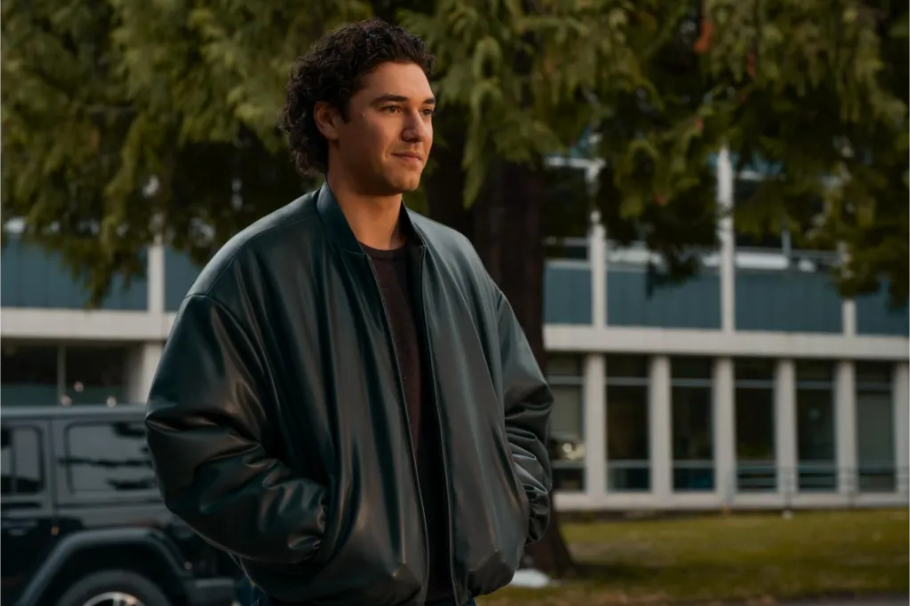
Garrett Graham works as a character because underneath the surface-level “cocky hockey captain” persona is someone fundamentally terrified of becoming his father. That fear defines almost everything about him throughout Off Campus, both in the book and especially in the television adaptation. At first glance, Garrett appears to fit the stereotypical college romance male lead archetype. Confident, charming, popular, emotionally untouchable. But the deeper the story goes, the more it becomes clear that much of Garrett’s confidence is performative. Hockey, humor, flirting, even arrogance… all of it becomes a shield he uses to control how other people perceive him.
What makes Garrett compelling is that his emotional conflict is not centered around whether he deserves love, but whether he is capable of becoming dangerous. That’s the thing haunting him the entire story. His trauma does not manifest through emotional withdrawal alone. It manifests through hypervigilance surrounding his own anger. The show especially emphasizes this through his reaction after beating up Delaney. For many viewers, the breakup change felt controversial because it deviated from the book, where Hannah leaves him after pressure from Phil. But psychologically… I actually think the adaptation made it hit harder. Garrett’s violence against Delaney is not portrayed as some triumphant “hero moment.” The scene immediately shifts into fear. Real fear. Because the second Garrett loses control physically, it triggers his deepest fear: that he is fundamentally no different from his abusive father.
This becomes especially clear in the dialogue where Garrett admits, “I couldn’t protect her. My mom. I tried, but I couldn’t fight back,” followed by, “What if I’m just like him?” That moment is basically the core of Garrett’s character in one scene. His protectiveness toward Hannah is not simply possessiveness or masculinity or him trying to play the hero. It’s rooted in unresolved guilt and helplessness from childhood. Garrett carries the belief that he failed to protect his mother, and because of that, he overcompensates whenever someone he loves is threatened. Yet the moment he loses control physically, that protection immediately transforms into fear. He is not afraid of punishment or consequences. He is afraid that violence exists inherently within him.
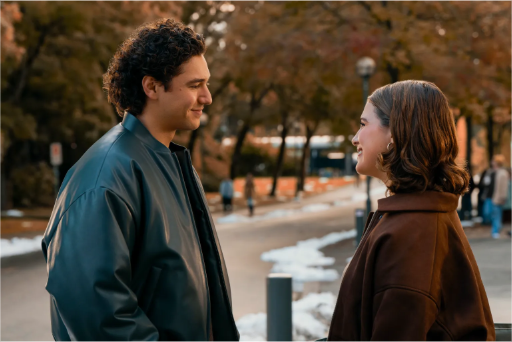
This is why Hannah’s role in Garrett’s story matters so deeply. Hannah becomes one of the first people around whom Garrett no longer has to perform confidence or emotional invulnerability. Unlike the rest of the world, hockey scouts, teammates, girls, his father, the university… Hannah sees through the persona almost immediately. Their relationship works because both characters carry trauma that shapes the way they perceive themselves. Hannah believes her past ruins people’s lives, while Garrett believes his anger will define his future. The breakup in the show forces both of them to confront those fears directly. Hannah internalizes Garrett’s fight as proof that she destroys the people around her, while Garrett sees Hannah’s reaction and believes he has become frightening and unsafe. Ultimately, their reconciliation becomes powerful because they realize neither fear is true. Garrett defending Hannah was never her ruining his life, and Garrett’s trauma does not predetermine who he becomes.
Another reason Garrett succeeds as a character is because his softness is never written as the absence of masculinity. He remains competitive, impulsive, protective, stubborn, emotionally reactive… all of it. The narrative does not remove his flaws in order to make him lovable. Instead, it explores whether someone raised around aggression and emotional abuse can consciously choose tenderness, emotional openness, and safety despite what they were taught growing up. That complexity gives Garrett depth beyond the typical “book boyfriend” archetype.
The television adaptation strengthens this even further by translating Garrett’s internal monologue visually rather than through narration. Since the books are written heavily in first person POV, much of Garrett’s characterization originally exists inside his thoughts. The show compensates for this by emphasizing body language, silence, lingering looks, reactions, vulnerability with the boys, and small behavioral shifts. Episode four in particular functions almost entirely as Garrett’s emotional POV without explicitly stating it. His yearning is communicated through actions rather than words. Watching Hannah perform, opening up to his friends, stalking her Instagram, slowly allowing himself to emotionally depend on someone else… those choices communicate everything. They show a really strong understanding of adaptation because they externalize what originally existed internally on the page.
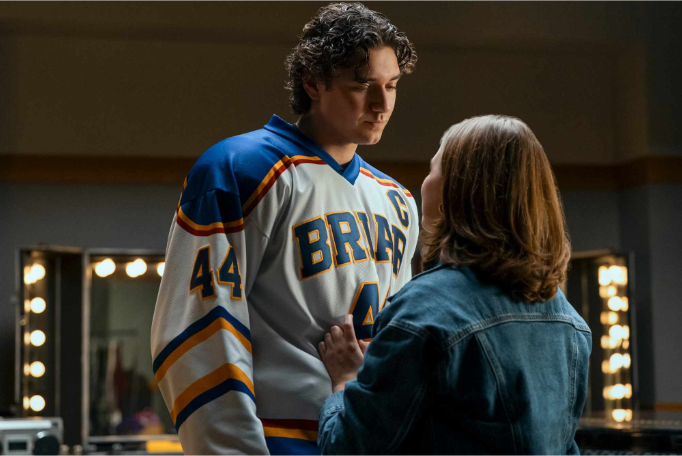
Ultimately, Garrett Graham resonates because he represents a very specific emotional conflict: the fear that trauma is inherited and unavoidable. His journey is not simply about falling in love with Hannah. It’s about learning that his past does not define his future, that anger does not make him abusive, and that vulnerability is not weakness. Beneath the hockey captain persona is someone desperate to prove to himself that he is capable of becoming something softer, safer, and better than the man who raised him.